Wednesday, May 23, 2012

Computer games on the brain

Violent video games and other computer entertainment have long been criticised for damaging a youngsters’ brain.

But activists such as Oxford Professor Baroness Greenfield have often presented little science to back up their allegations. However, extensive research into the subject has now provided worrying results that support her claims.

‘Screen technologies cause high arousal which in turn activates the brain system’s underlying addiction,’ the neurologist said last month in an attack that accused games of causing ‘dementia’ in children. ‘This results in the attraction of yet more screen-based activity.’

And now the first genuinely scientific attempt to analyse the emotive subject has thrown up astonishing results that suggest she is right....

For the rest of this article by Rob Waugh, originally published in the UK Mail have a look at this link

Monday, May 21, 2012

Finding the Leonardo in ourselves


The Class Seven year brings a study of the Renaissance in Europe – the flourishing of the arts, a rediscovery of the cultural treasures of Ancient Greece and Rome and an awakening to the wider world – geographically, scientifically and artistically. 


This year the theme has brought studies in and experiences of perspective drawing, Renaissance biographies, the use of mathematical tools developed in the Renaissance (Napier’s Bones), the various guilds that developed during the Renaissance and the artistic works, methods and motivations of Renaissance masters such as Leonardo da Vinci.
 
Later in the year the same theme will lead us into Astronomy, the Geography of Africa and the Americas, Mechanics and other learning areas, as the children experience the discoveries and developments that bloomed during this time.


Class 7 have been creating lots of drawings to connect with our renaissance theme. Shown here are some for you to enjoy.

Robin Hinkley


Starting school later is best, research says


New Research Evidence: The Longevity Project


The new evidence comes from an unlikely source – an extraordinary longitudinal research study based on a group of over 1,000 Californian children born early last century, and whose development was tracked from early childhood throughout their lives, until they died. More specifically, the Terman Life Cycle Study was initiated in 1922 by Lewis M. Terman as a study of gifted children in California. Participants were followed throughout their lives, with evaluations occurring every five to ten years. The research team of the resultant Longevity Project, led by Professor Howard S. Friedman of University of California in Riverside, supplemented this information with the collection of death certificates and the construction and validation of new psychosocial indices, including measures of personality, alcohol use and mental adjustment. The Terman data therefore offer a unique opportunity to look at the possible lifelong consequences of early educational milestones. Professor Friedman and his researchers used data from this sample to examine lifelong outcomes associated with ages at first reading and school entry.
Keep on playing kids!

Based on a review of the literature, the researchers hypothesised that entering school at a relatively early age would be associated with lower academic performance and worse psychosocial adjustment across the lifespan, including increased mortality risk. They also examined educational achievement, midlife health and mental adjustment, and alcohol use as potential mediators of these relations. 

The lead researcher of the Longevity Project, Dr Howard S. Friedman, Distinguished Professor of Psychology at the University of California in Riverside, said:

“In our work on The Longevity Project, an 8-decade study of healthy aging, we were amazed to discover that starting formal schooling too early often led to problems throughout life, and shockingly was a predictor of dying at a younger age. This was true even though the children in The Longevity Project were intelligent and good learners. I'm very glad that I did not push to have my own children start formal schooling at too young an age, even though they were early readers. Most children under age six need lots of time to play, and to develop social skills, and to learn to control their impulses. An over-emphasis on formal classroom instruction-- that is, studies instead of buddies, or ‘staying in’ instead of ‘playing out’ -- can have serious effects that might not be apparent until years later.”

Their findings, then, are unambiguous and dramatic: to quote the researchers’ 2009 paper from the Journal of Applied Developmental Psychology, “Early school entry was associated with less educational attainment, worse midlife adjustment, and most importantly, increased mortality risk”.
                   
Commentary on the Findings
These research findings are somewhat counter-intuitive, in that the sampled children were actually of above-average intelligence. This has considerable implications for how we, as a society, respond educationally to bright children. The conventional wisdom is that naturally intelligent children should have their intellect “fed” and “stimulated” at a young age, so they are not “held back”, as conventional thinking has it. Yet these new empirical findings strongly suggest that exactly the opposite may well be the case, and that young children’s “run-away” intellect actually needs to be slowed down in the early years, if they are not to risk growing up in an intellectually unbalanced way, with possible life-long negative health effects.

Whilst it is always important to treat “positivistic” research of this kind with caution and not generalise uncritically or recklessly from it, what is so compelling about these new research findings is that they add robust empirical corroboration to the arguments that have been made by a host of authorities from education and psychology over many decades – including Donald Winnicott, Maria Montesssori, Rudolf Steiner, Professors David Elkind, Lilian Katz and Neil Postman, and the Ypsilanti High/Scope Project – that an introduction to early, overly formal  institutional schooling has negative health effects on young children that can be life-long in impact.  

Download the full media release  here.


Thursday, February 9, 2012

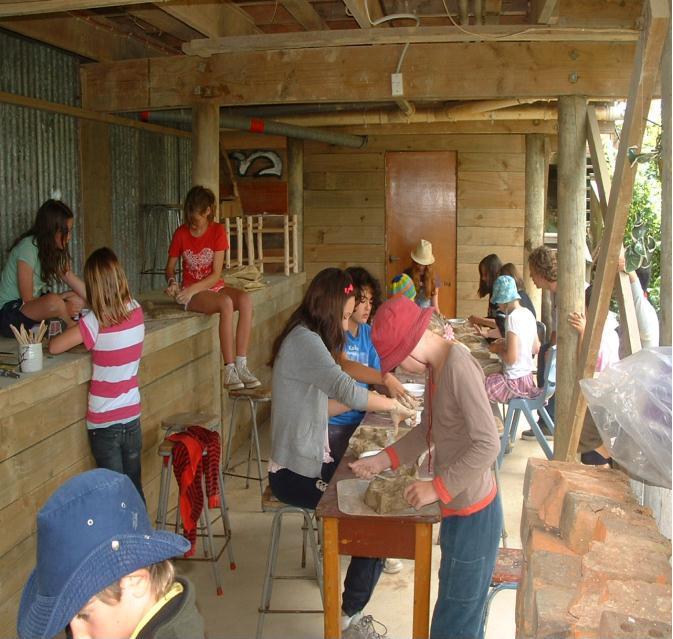
Lower School Hands On

Outdoor activites in the Lower School to start the year of 2012 include:


Felt making,
a Hangi,
mud murals,
soap making,
bush cooking,
trail blazing,,
creek boat building
mat making and....


 constructing a labyrinth out of wood.

Monday, December 19, 2011

An Outdoor Classroom

At Raphael House we are fortunate to be surrounded with a large area of wild bush covered hillsides.


This has allowed for the creation of many interesting projects around the school, such as gardens, play areas and even mountain biking tracks.


A recent continuation of this tradition has been an outdoor classroom with a fireplace surrounded by a circle of benches. This area has multiple uses as a fire circle for Lower School story telling, as well as a forge for making pottery and use as a smithy.


In these photos you can see Philip Robinson and Brett Whincup throwing their energy into creating the new outdoor education space in its early stages.


The area is also used for charcoal making, which involves wood collecting, sawing, splitting and stacking. When willow sticks are used, these can become charcoal sticks for use in Upper School art lessons. Its all part of the idea of making educational experiences practical and interconnected.

Thursday, December 15, 2011

Ex Raphael House student investigates antarctic sea ice

Andrew Martin at work in Antarctica
Andrew Martin was in the first pioneering class 12 that graduated from the Upper School at Raphael House in 1996.

After leaving school he studied animal and plant biology at Victoria University, and subsequently specialised in the microbes that live under the sea ice around Antarctica. These inconspicous little creatures have a huge influence on the Southern Ocean ecosystem because they are at the very base of the food chain upon which all the rest of the animals depend.
Andrew and his team drill through the sea ice for samples
Andrew has been on numerous expeditions to the frozen continent.
His research looks at how climate change will impact on these microbes as the sea ice is affected by warming of the sea water.

Andrew featured on Radio New Zealand's 'Nine to Noon' programme recently, where he explained his research from down on the ice to radio host Kathryn Ryan. Click here to listen to this interesting interview (9 mins 38 sec)

Tuesday, December 13, 2011

Class Three Building

This term Class Three have been working on their house building main lesson. In it we look into the history of house building and learn about some different types of houses, such as yurts and igloos, noting how they suited the environments they were used in. We also heard about animals that make their own houses, including beavers.

A house provides not only a shelter for us against the elements, but also a place of security and warmth, a place of community and comfort.

Class Three were lucky to have an experience of this on a small scale when they made shelters up in the pine forest. The pine forest is a familiar and beloved place for the children and they found a corner if it to make their own. They spent nearly three weeks (with much disruption from the weather) building, using wood, flax, coffee sacks, flax, bracken and ponga ferns. With parent support the children sawed, nailed and carried, working with focus to create their beautiful ‘homes’.

All the while they were envisaging how their shelter would be set up for the sleepover we were planning. They worked with their groups to create a special space to house them for one night. By creating this vision together there was a lovely sense of community within the groups.
When the sleepover finally arrived, with perfect weather, the children had indeed created a secure, safe space where they could comfortably sleep the night. They had a great time, from setting up their gear to a campfire with damper and marshmallows.

Purdy Biddle, Class Three Teacher.